AInxiety, What is Going On?

IAnsiedad, ¿Qué está Pasando?

AInxiety, What is Going On?

The symptom

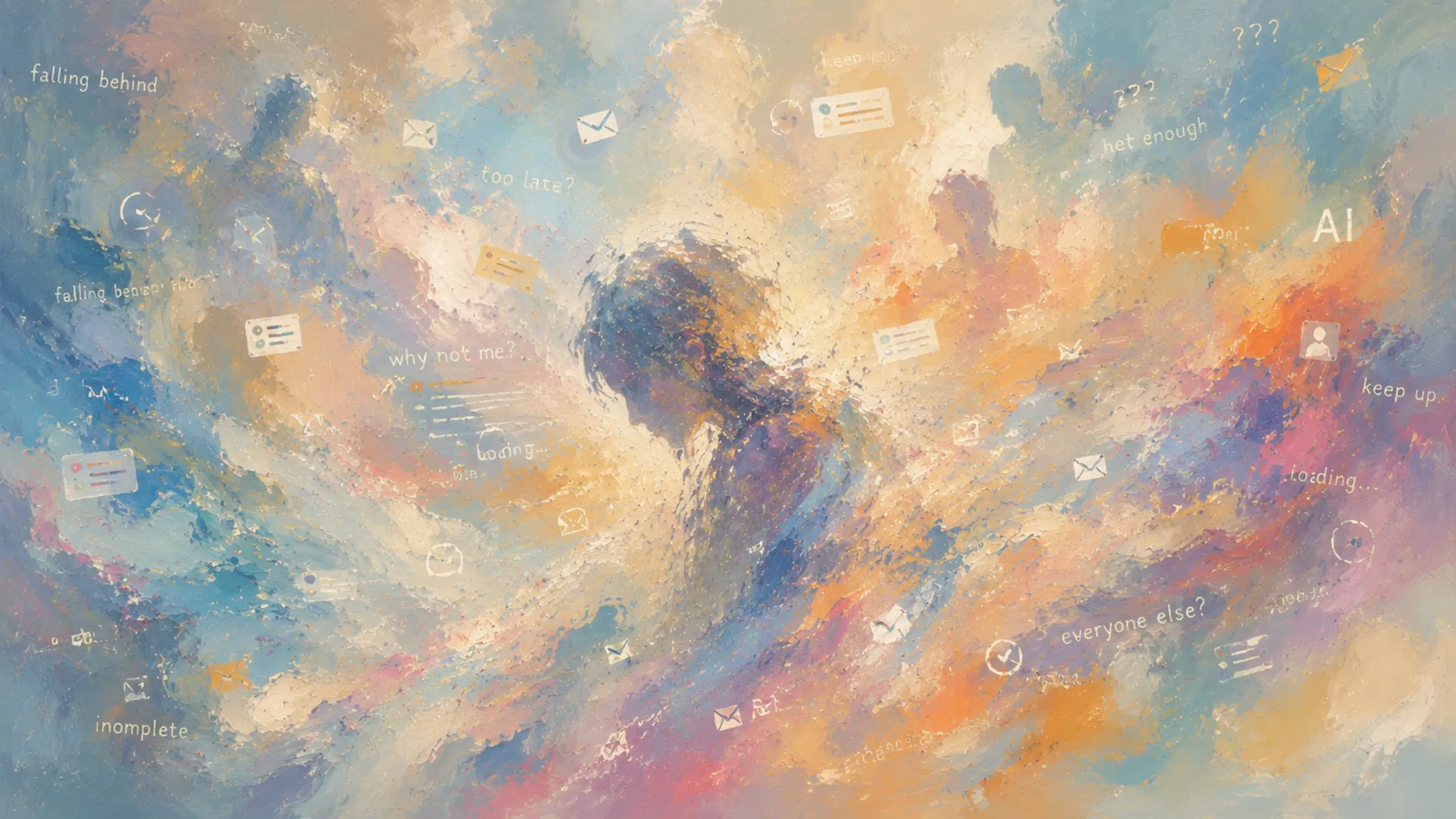
You open LinkedIn on a Tuesday morning. Three posts telling you that if you’re not using AI you’re already obsolete. One announcing a course on “mastering AI in 7 days.” Another from someone who just automated their entire company with an agent. And you, drinking your coffee, with that nagging feeling that you’re falling behind.

That has a name. It’s called AInxiety. And it’s more common than it seems.

But it’s not just LinkedIn. Every week Google DeepMind, Anthropic, OpenAI and the rest of the big labs launch something new. A more powerful model. A capability that didn’t exist before. A benchmark surpassed. The pace is so fast it’s almost impossible to keep up with everything. I ended up automating my own newsletter just to filter the noise. Because if you don’t, the volume buries you.

AInxiety isn’t abstract fear of the future. It’s a constant, daily pressure that mixes the noise of social media with the real speed of technology and produces something quite uncomfortable: the feeling that nothing is ever enough, that there’s always something new to learn, something to adopt, something you can’t afford to ignore.

The problem is that feeling, for the most part, is manufactured.

The paradox nobody mentions

There’s a 19th century concept that explains very well what’s happening. It’s called the Jevons paradox. When more efficient steam engines were invented, logic suggested coal consumption would drop. The opposite happened: efficiency made coal cheaper to use, so it was used for more things, in more places, by more people. Total consumption skyrocketed.

With AI, exactly the same thing is happening.

A study from UC Berkeley’s Haas School of Business published in Harvard Business Review in 2026 tracked employees at a company that adopted AI tools for eight months. The result was uncomfortable: employees worked faster, took on a broader scope of tasks, and extended their working hours. Nobody asked them to. They did it on their own because AI made “doing more” feel possible and accessible.

We’re not going to work less because AI is faster. We’re going to work more, on more problems, in less time. The demand for productivity doesn’t shrink when it gets cheaper. It expands.

If you’re waiting for AI to give you your afternoons back, that expectation might need revisiting.

The problem with the tool that does everything

AI can write, code, analyze data, search for information, generate images, summarize documents, translate, make presentations. And that’s exactly the problem.

When a tool does too many things, most people don’t know what to do with it.

I’ve seen companies pay for AI subscriptions for months without using them in any meaningful way. Not because the tool is bad. But because nobody stopped to ask what specific problem they wanted to solve. They buy the tool first. Look for the problem after. And many times they never find it.

The people who get the most out of these tools aren’t the ones who know the most about AI. They’re the ones who are very clear about which part of their work they want to improve. A tool that does a thousand things doesn’t give you an advantage on its own. Knowing exactly what you’re using it for does.

The useful question isn’t “what can AI do?” It’s “what specific task in my day do I want to stop being my problem?”

The anxiety business

This isn’t a coincidence. AInxiety is also a market.

Every time someone feels like they’re falling behind, someone else shows up ready to sell them the solution. Courses on “mastering AI in a month.” Prompt engineering masterclasses. Consultants who will help you “transform your company with AI” before it’s too late.

I’m not saying all of that is bad. But a significant part of it feeds directly off fear, not off real value. Worth keeping in mind before reaching for your card.

And there’s something else AI is doing to us, this time at a cognitive level, that deserves attention. I’m looking into exactly that for the next article, and the data I’ve found is fairly unsettling. I’ll give you a preview here: AI might be making us a little less sharp without us noticing. More on that soon.

Relax. Reality moves slower than your feed

Here’s the part nobody talks about.

According to McKinsey’s State of AI 2025 report, 88% of companies already use AI in some function. That sounds like total transformation. But the same report says only a third have managed to scale it meaningfully across their organization. And only 6% are seeing real financial impact.

In other words: almost everyone has the tool. Very few know what to do with it.

Big technological shifts always look faster from the outside than from the inside. The internet took decades to truly change how we work. So did the smartphone. AI won’t be different in that sense.

That doesn’t mean it won’t change things. It will. But the real timeline is more human than the headlines suggest. You have time to learn, to experiment, to make mistakes and correct them. You don’t need to know everything tomorrow.

AInxiety thrives on constant comparison and infinite scroll. The antidote isn’t another course or another tool. It’s asking yourself one simple, honest question: what specific problem do I actually want to solve with this?

If you have an answer, go for it. If you don’t, waiting isn’t falling behind. It’s being smart.

El síntoma

Abres LinkedIn un martes por la mañana. Tres posts diciéndote que si no usas IA ya estás obsoleto. Uno anunciando un curso de “domina la IA en 7 días”. Otro de alguien que acaba de automatizar toda su empresa con un agente. Y tú, tomando el café, con la ligera sensación de que te estás quedando atrás.

Eso tiene nombre. Se llama IAnsiedad. Y es más común de lo que parece.

Pero no es solo LinkedIn. Cada semana Google DeepMind, Anthropic, OpenAI y el resto de los grandes labs lanzan algo nuevo. Un modelo más potente. Una capacidad que antes no existía. Un benchmark superado. El ritmo es tan alto que resulta casi imposible seguirlo todo. Yo mismo acabé automatizándome una newsletter solo para filtrar el ruido. Porque si no, el volumen te aplasta.

La IAnsiedad no es miedo al futuro en abstracto. Es una presión constante, cotidiana, que mezcla el ruido de las redes con la velocidad real de la tecnología y produce algo bastante incómodo: la sensación de que nunca es suficiente, de que siempre hay algo nuevo que aprender, algo que adoptar, algo que no puedes permitirte ignorar.

El problema es que esa sensación, en gran parte, está fabricada.

La paradoja que nadie menciona

Hay un concepto del siglo XIX que explica muy bien lo que está pasando. Se llama la paradoja de Jevons. Cuando se inventaron máquinas de vapor más eficientes, la lógica decía que se consumiría menos carbón. Ocurrió lo contrario: la eficiencia hizo que usar carbón fuera más barato, así que se usó para más cosas, en más sitios, por más gente. El consumo total se disparó.

Con la IA está pasando exactamente lo mismo.

Un estudio de la Haas School of Business de Berkeley publicado en Harvard Business Review en 2026 siguió durante ocho meses a los empleados de una empresa que adoptó herramientas de IA. El resultado fue bastante incómodo: los empleados trabajaron más rápido, asumieron más tareas y extendieron su jornada. Nadie se lo pidió. Lo hicieron solos porque la IA hacía que “hacer más” se sintiese posible y accesible.

No vamos a trabajar menos porque la IA sea más rápida. Vamos a trabajar más, para más problemas, en menos tiempo. La demanda de productividad no se reduce cuando se abarata. Se expande.

Si estás esperando que la IA te dé las tardes libres, igual hay que revisar esa expectativa.

El problema de la herramienta que lo hace todo

La IA puede escribir, programar, analizar datos, buscar información, generar imágenes, resumir documentos, traducir, hacer presentaciones. Y eso es exactamente el problema.

Cuando una herramienta hace demasiadas cosas, la mayoría de la gente no sabe qué hacer con ella.

He visto empresas pagar suscripciones de IA durante meses sin usarlas de forma real. No porque la herramienta sea mala. Sino porque nadie se paró a preguntarse qué problema concreto querían resolver. Compran la herramienta primero. Buscan el problema después. Y muchas veces no lo encuentran.

La gente que más partido saca a estas herramientas no es la que más sabe de IA. Es la que tiene muy claro qué parte de su trabajo quiere mejorar. Una herramienta que hace mil cosas no te da ventaja por sí sola. Te la da saber exactamente para qué la usas.

La pregunta útil no es “¿qué puede hacer la IA?”. Es “¿qué tarea específica de mi día quiero que ya no sea mi problema?”

El negocio de la ansiedad

Hay algo que no es casualidad. La IAnsiedad es también un mercado.

Cada vez que alguien siente que se está quedando atrás, aparece alguien dispuesto a venderle la solución. Cursos de “domina la IA en un mes”. Másteres de prompt engineering. Consultores que te ayudan a “transformar tu empresa con IA” antes de que sea tarde.

No digo que toda esa oferta sea mala. Pero sí que una parte importante de ella se alimenta directamente del miedo, no del valor real que aporta. Y conviene tenerlo presente antes de sacar la tarjeta.

Y hay algo más que la IA nos está haciendo, esta vez a nivel cognitivo, que merece atención. Estoy investigando exactamente eso para el siguiente artículo, con datos que me han resultado bastante inquietantes. La adelanto aquí: puede que la IA nos esté volviendo un poco más torpes sin que nos demos cuenta. Más sobre eso pronto.

Tranquilo. La realidad va más despacio que el feed

Aquí viene la parte que nadie cuenta.

Según el informe State of AI 2025 de McKinsey, el 88% de las empresas ya usa IA en alguna función. Suena a transformación total. Pero el mismo informe dice que solo un tercio ha logrado escalarla de verdad dentro de su organización. Y únicamente el 6% está obteniendo un impacto financiero real.

Dicho de otra forma: casi todos tienen la herramienta. Muy pocos saben qué hacer con ella.

Las grandes transformaciones tecnológicas siempre parecen más rápidas desde fuera que desde dentro. Internet tardó décadas en cambiar de verdad cómo trabajamos. El móvil también. La IA no va a ser diferente en ese sentido.

Esto no significa que no vaya a cambiar cosas. Va a cambiarlas. Pero el timeline real es más humano de lo que los titulares sugieren. Tienes tiempo para aprender, para experimentar, para equivocarte y corregir. No hay que saberlo todo mañana.

La IAnsiedad prospera en la comparación constante y en el scroll infinito. El antídoto no es otro curso ni otra herramienta. Es hacerse una pregunta simple y honesta: ¿qué problema concreto quiero resolver con esto?

Si tienes respuesta, adelante. Si no la tienes, esperar no es quedarse atrás. Es ser inteligente.